Confidentiality Notice
To protect proprietary and confidential information, details regarding this project have been generalized. All included visuals are non-proprietary login flows or abstracted artifacts. For a more in-depth discussion, please contact me directly.
My Core Role
Lead UX/UI Designer & Strategic Generalist
Team Structure
- CEO Stakeholder
- 1 Product Manager/QA Engineer
- 1 Lead Developer
- 3–6 Developers
My Contributions
- UX/UI
- Design System Completion
- Stakeholder & Dev Liaison
- In-house Software User/Tester
- Content Strategy
- Business Dev. & Management
The Challenge & The Strategic Pivot
Context:
My main stakeholder was the CEO of an engineering consulting company in the highly regulate Commissioning, Qualification, and Validation space.
The main stakeholer goals were to improve an in-house product that they had developed as inustry experts with software engineers and were now piloting with external users as a SaaS product with high revenue potential.
My UX/UI specific tasks were to make it "pretty", a more intuitive user experience, and help build out the increased amount of new modules and features.
My role was multi-disciplinary across the company which gave me industry context and exposure to business development strategy allowing me to see more clearly the ties between improving UX/UI and overall business development goals.
This exposure and ability to work with the CEO allowed me to understnad how the primary stakeholder viewed the application and it's progress.
My initial hypothesis: we will improve based on UX research and build our designs upon a wealth of knowlege.
The reality: The motivation and perceived business value of UXR was low due to a variety of factors. I began ideating, sketching, and creating mockups before having a full understanding of the product and the industry due to urgent business needs.
I realized I would have essentially no basis of product specific UXR to build off of and I will be working on UX/UI while I learn the industry and application.
Updated hypothesis/goal: to improve the application in terms of usability and aesthetics by independent research, in-house trainings, and any opportunity to get feedback.
Implementation & Core Artifacts
My process was a rapid loop of briefs, ideate, design solution(s), review, repeat previous steps if needed, and ship.
My Process & Approach to Solutions
Given the constraints of a niche B2B product and limited access to the target user base, I approached design with a resourceful, agile, and highly collaborative mindset.
My process was a rapid loop of briefs and research wherever possible, ideate, design solution(s), review with collaborators, repeat previous steps if needed, and ship.
Main Challenge
Most solutions were urgent, same day deliverables in response to a key user friction point or business evelopment blocker. This meant frequent meetings between the lead developer and myself to brief, review designs, update, and hand off.
In some cases, there were larger more complex features that were eveloped over many months such as a complex dashboard screen that had hundreds of iterations with new sub-features, dashboards, and forms within.
For longer term deliverables, the process was the same except with added space for more research and occasional user calls, trainings, and more formal feedback sessions.
Design Process Flow
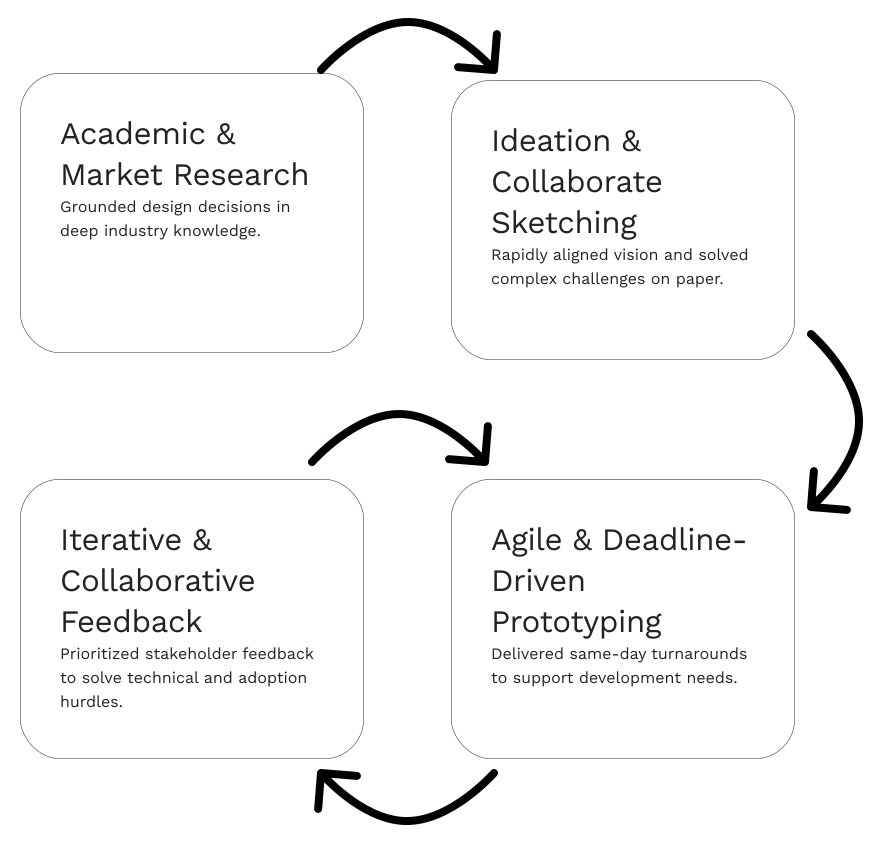
The typical Vektor design process, from foundational research to collaborative feedback and final implementation.
1. Foundational Design Systems
I took ownership of the design system, ensuring a high level of fidelity and alignment with WCAG AA/AAA contrast standards. This was critical for streamlining the handoff process and aligning new engineering hires.
The textfield component documentation served as the single source of truth for input interactions across all modules.
2. Complex User Flow Mapping
For large modules, I created high-level user flow sketches to define the Information Architecture and account for all complex, multi-path user journeys before moving to high-fidelity mockups.
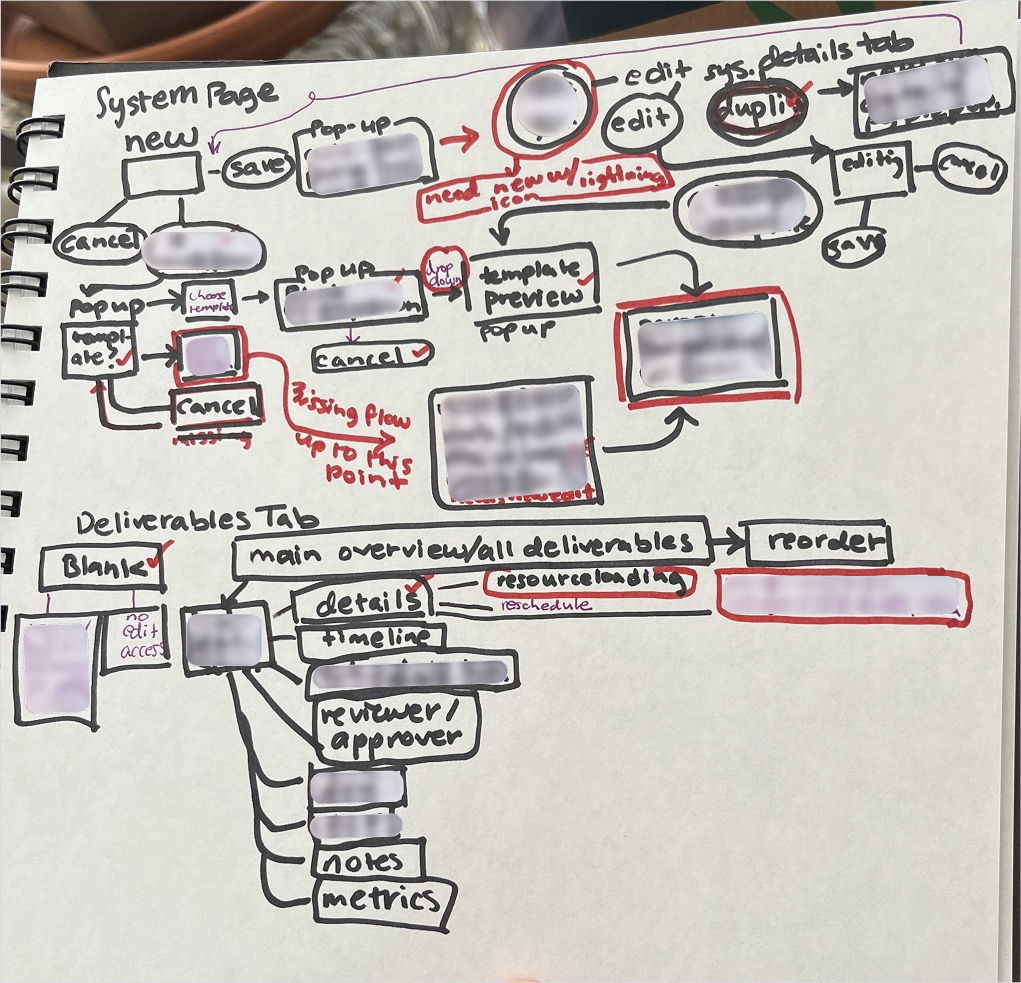
A high-level sketch mapping the possible paths and architecture for a major module's main page.
3. Edge-Case Design & Error Handling
By mapping out comlpex user flows and prototyping, we were able to find edge cases and potential user errors so we could give clear, human-centered feedback instead of generic errors in order to increase retention and user satisfaction.
4. Polished Authentication Flow
I redesigned the entire sign-in, verification, and password recovery flow, ensuring a modern look that aligned with the new design system and providing clear visual cues for multi-factor authentication steps.
Outcome & Strategic Impact
100%
Adoption Increase (Internal Users)
20+
Modules Redesigned/Created
1
Centralized Source of Truth (Reduced data sprawl)
The redesign achieved its core goals. By making the application aesthetically superior and consistently usable, we successfully onboarded all internal users to critical weekly functions (Timesheets and Expense reporting), proving Vektor’s value and providing a massive, built-in feedback loop.
Strategic Differentiator: Content as a driver for sales and business development.
Success in this environment required being a strategic generalist—a designer who could pivot priorities, balance multiple ongoing projects/deliverables, and drive the overall commercial narrative. I would say this area is my biggest area for growth and going back I would have taken more ownership and approached marketing materials from a UX perspective sooner than I did and created more MVPs.
Learnings & Professional Growth
This project was a significant accelerator for my professional growth. Moving from working with a two-person design team to a larger, complex team and into a leadership role within the first 3 months taught me the importance of adaptibility and emphasis on systems rather than one-off solutions. For example, focusing on a design system not just for consistency, but as a communication tool to maintain velocity across multiple developers will provide value long after I am gone.
My key learnings centered on the business-UX relationship. I gained a deep appreciation for how understanding CEO goals directly translates into prioritizing which features to build first (e.g., Timesheets for adoption over complex niche tools). Crucially, I learned that system thinking applies everywhere. Building solid, repeatable business processes (like improving budget reviews) first made it infinitely easier to translate those requirements into the app, improving the end-user experience.
Finally, I grew in confidence. Early on, I wish I would have been more assertive in both owning what I knew and clearly articulating what I didn't. This experience taught me to recognize the value of my unique position and expertise, making me a more effective and decisive lead designer.